Pet friendly hotels: how to welcome guests traveling with a dog (and get chosen)
Talk to Made by West
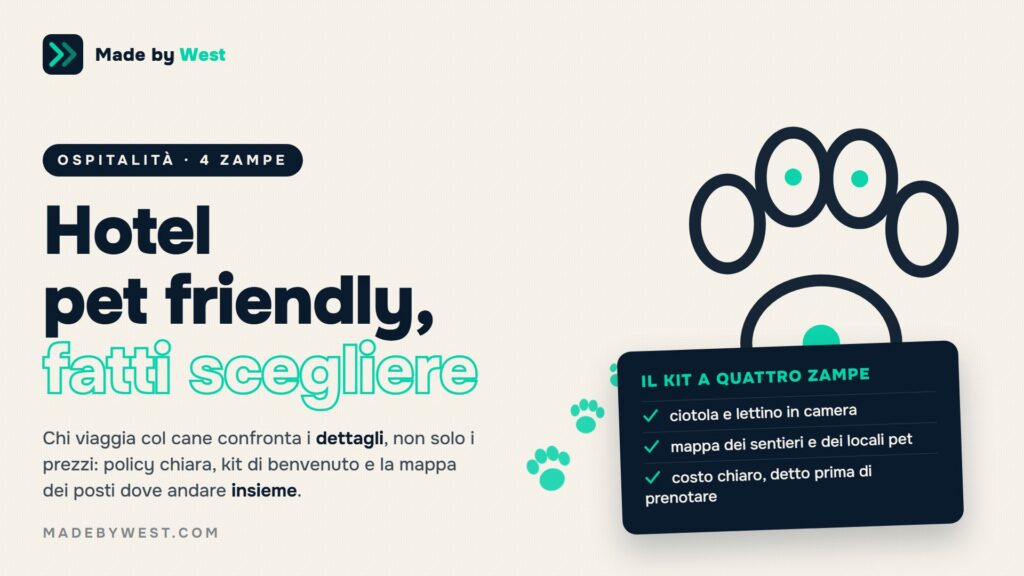
A pet friendly hotel works when the answer to dogs is written in black and white: a clear policy on your website (fees, rules, where the dog is allowed), a room that genuinely welcomes it (bowl, bed, towel) and a list of nearby places you can visit together. People traveling with a dog are looking for exactly that — and once they find it, they stop comparing prices and start comparing details. In Italy and Europe, families with animals are a slice of demand many properties handle with embarrassment, when it is one of the easiest to turn into loyalty: the dog checks in once, the family comes back three times.
What do guests traveling with a dog ask before booking?
The questions are always the same, and whoever asks them has usually already looked at the photos and the prices: «How much does the dog cost?», «Is it allowed in every room or just some?», «Is there a garden where I can take it?», «Can I leave it for a couple of hours if I go out?». If your website has no page answering these questions, the booking ends somewhere else — or on the phone, which is already friction. The simplest move is a “Pets welcome” section or page with:
- the nightly fee (or the choice not to charge one, stated openly);
- the rooms where dogs are allowed and whether there is a size limit (if there isn’t, write it: it’s an advantage);
- included services: bowls, bed, towel, waste bags;
- nearby dog-friendly places: restaurants, beaches, trails, green areas;
- what to do if the guest wants to go out without the dog (a partnered dog sitter, or the honesty of saying you don’t have one).
How to build the pet friendly welcome (the moves)
You don’t need a canine department: you need five things done well. First, the four-paws welcome kit — bowl, bed, a biscuit — costs little and ends up in the guest’s photos. Second, the “where can we go together” map of the surroundings, which you can print or put in your property’s app. Third, a clear rule about breakfast and shared areas (where yes, where no), because uncertainty makes even guests without animals uncomfortable. Fourth, the cleaning pact: a small deposit or a serene note about possible damages avoids arguments. Fifth, memory: whoever arrives with a dog goes into the guest profile, so on their return finding the “dog room” ready becomes the detail they tell everyone about.
How much should the dog’s stay cost?
Two honest paths: a flat nightly fee (practical, predictable) or a named pet package — «Fido Package: bowl, bed, trail map, welcome biscuit» — which turns a cost into a service. What doesn’t work is the hidden fee announced at arrival: it’s the fastest way to turn a dog lover into a lukewarm review. Whatever you choose, publish it.
Frequently asked questions about pet friendly hotels
Large dogs: yes or no? If the property allows it, saying so openly is a competitive advantage: many places refuse them, and whoever owns a labrador is looking precisely for the ones who don’t.
And if another guest is allergic? Rooms used by guests with animals should sit in one area and be cleaned with dedicated products: that way you can promise both things without embarrassment.
Can the dog stay in the breakfast room? It depends on local rules and your spaces: the answer that matters is the written one, not the one improvised at the door.
In brief
A pet friendly hotel wins with clarity: a published policy, a welcome kit, a map of dog-friendly places and a surcharge announced in advance. People traveling with a dog choose the property that answers these questions before they’re asked — and come back, because they rarely find all of it elsewhere.