Scent marketing in hotels: what it is and how to use it (the scent guests remember)
Book your free call
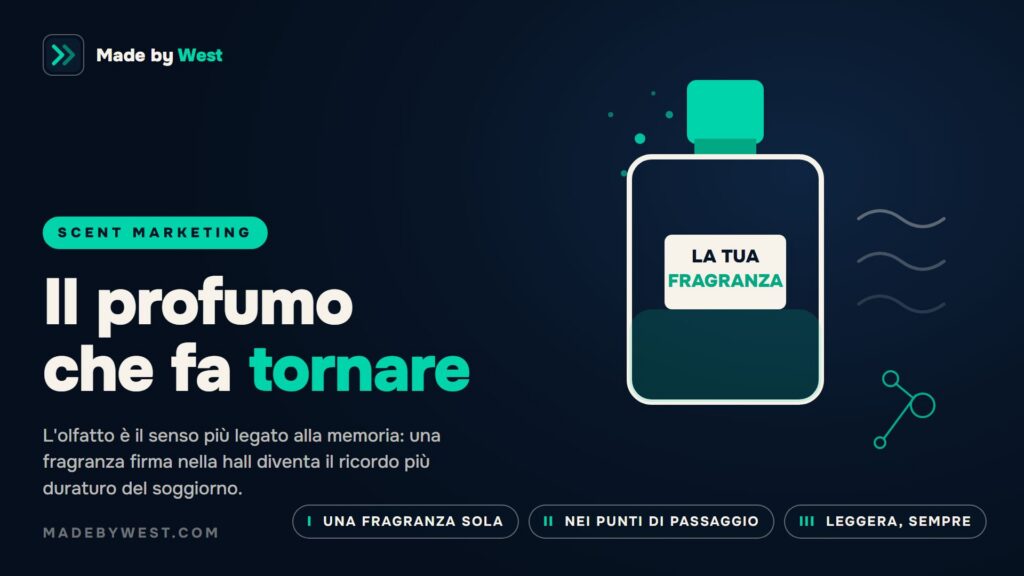
Scent marketing is the deliberate use of a fragrance in your property — lobby, corridors, linen — to create an impression guests remember and recognize. It works because smell is the sense most tied to emotional memory: a scent brings back a place faster than a photo. Whoever walks into a lobby that smells distinctively is already forming an opinion, before registering anything consciously. It’s invisible branding: it doesn’t show on the website, it can’t be photographed, but it sticks.
Why do guests remember a scent more than your prices?
Because olfactory memory bypasses reasoning: nobody compares scents on a booking portal, but everyone remembers “that hotel that smelled wonderful”. You forget a price within a week; the smell of the lobby comes back to you years later, together with the memory of the stay. That’s why the big chains have an official signature fragrance, chosen and diffused with the same care as the logo: they know a guest can’t share it on Instagram, but they can find it again — and finding it again is what generates the return. An independent property can do exactly the same thing with a fragrance of its own.
How to choose your hotel’s scent?
The criterion is context, not personal taste. The moves:
- start from the property’s character: wood and spices for a countryside relais, fresh linen and citrus notes for a seaside house, leather and sweet tobacco for a historic palazzo;
- one fragrance only, not a different one per floor: recognisability is born from repetition;
- test it where it will live: the same scent changes in a tall airy lobby and in a carpeted corridor;
- keep it below the threshold of consciousness: the guest should feel “how lovely it is here”, not “what is that smell?»;
- extend it consistently: the same note in the room detergent or in the hand soap completes the story.
Where to diffuse it (and where not to)
The hot spots are the lobby, reception and corridor floors: the passing places where the impression forms. In the rooms, deep cleaning and cared-for linen beat any insistent diffuser — the room is where the guest sleeps, and sleep wins over branding. Avoid the opposite trap too: perfume used to cover mustiness or kitchen smells, which guests recognize instantly and which communicates neglect. Solve the source first, then perfume.
Frequently asked questions about scent marketing
How much does it cost? There’s a wide range: from candles and reed diffusers for small properties to professional diffusers for large spaces. You can start from the reception alone and watch how guests react.
Can it bother people? Yes, if it’s strong or cloying: that’s why the rule is lightness. Sensitive or allergic guests must be considered — better clean, natural notes than intense compounds.
Do I need a registered signature scent? No: you need a coherent choice, constant over time. Repetition is what signs the memory.
In brief
Scent marketing is choosing a recognizable fragrance for your property and diffusing it in the passing places: one scent, coherent with the character of the place, light, extended to soaps and linen. It costs little compared to a campaign, it can’t be copied with a photo, and it’s one of the few tools that works directly on the guest’s memory — which is where the return is born.