The menu that sells: the words that make a dish chosen before the first bite
Talk to Made by West
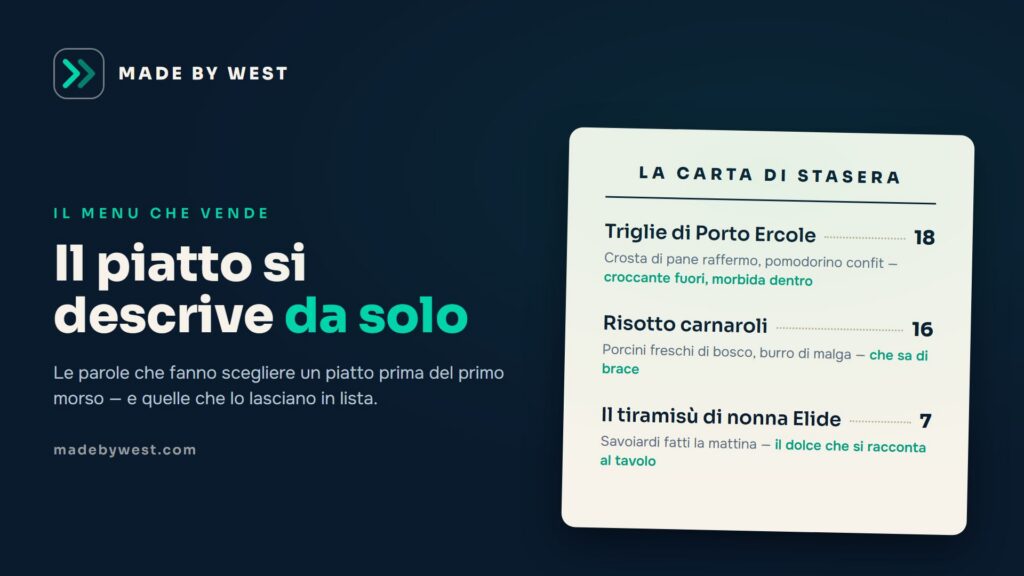
Two restaurants, same town, same red mullet. First menu: “Red mullet, cherry tomato and olives”. Second: “Porto Ercole red mullet, crust of day-old bread, confit cherry tomato”. Same fish, two destinies: one gets chosen, the other waits. The difference isn’t the kitchen — it’s the words.
The menu is the only salesperson that works every night, at every table, never tired. And almost everyone writes it in a hurry, like a shopping list. Here’s how to write a menu that works for you.
1. Name the origin (the real one)
“Prawns” is an ingredient. “Mazara del Vallo prawns” is a story in three words. Origin — the place, the producer, the variety — is the fastest way to say quality without saying the word “quality”, which means nothing anymore.
2. Describe what happens in the mouth, not the recipe
Nobody chooses a dish for the sequence of kitchen operations. It’s chosen for the promise of a sensation: crunchy, creamy, enveloping, fresh, tasting of embers. The procedure you tell at the table, if asked: the menu needs the verbs of pleasure, not of preparation.
3. The dish’s name counts as much as the dish
Short, evocative names that stick and get retold at the table: “The tuna that marinates in lemon” stays in mind longer than “Yellowfin tuna tartare with citrus emulsion”. Careful with the opposite direction: fantasy names with no connection to the dish confuse. Evoke, don’t hide.
4. Remove the empty words
“Delicious”, “special”, “homemade”, “tasty”: adjectives you could paste on any dish of any restaurant in the world sell nothing. If a word can sit on every menu on earth, it shouldn’t be on yours.
5. Price and position work in silence
- The dish you want to sell most sits at the top or center of its category, not at the bottom of the page.
- Avoid the right-aligned price column: it invites arithmetic comparison instead of desire.
- Never remove the price: guests distrust whoever hides it.
6. The format tells a story too
A digital menu you can update in one minute lets you do the most powerful thing that exists: remove the dish that doesn’t work and give space to the one that does. The paper menu gets reprinted once a year; the digital one learns every month. If you have a QR on the table, that’s your testing ground.
Before and after: five examples
- “Grilled beef steak” → “Scottona steak, rosemary and Cervia salt”
- “Mushroom risotto” → “Carnaroli risotto, fresh porcini from the woods, mountain butter”
- “Seafood spaghetti” → “Spaghetti, telline clams and datterini — the sea in just two things”
- “Homemade tiramisu” → “Grandma Elide’s tiramisu (sponge fingers made every morning)”
- “Mixed salad” → “Gianni’s garden salad, the one who brings us the zucchini”
Mini FAQ
Photos on the menu, yes or no? Yes if they’re yours, consistent and high quality; better few and right than many and mediocre. No to stock photos: they’re recognizable and lower everything.
Does it work with simple dishes too? Especially with those. A simple dish described well says “here, raw ingredients matter”; a simple dish described badly says “we can’t be bothered”.
How long should the menu be? Short. One page per category is already an ocean. Every extra dish splits attention and the kitchen’s rhythm.
In short
- The menu is a salesperson: write it like one.
- Origin, sensation, a name that sticks.
- Away with empty words that fit every menu on earth.
- Position and price work as hard as adjectives.
- The digital menu learns monthly: use it to see what gets chosen.
Want to go through your menu together and rewrite the dishes that don’t push? Let’s talk.