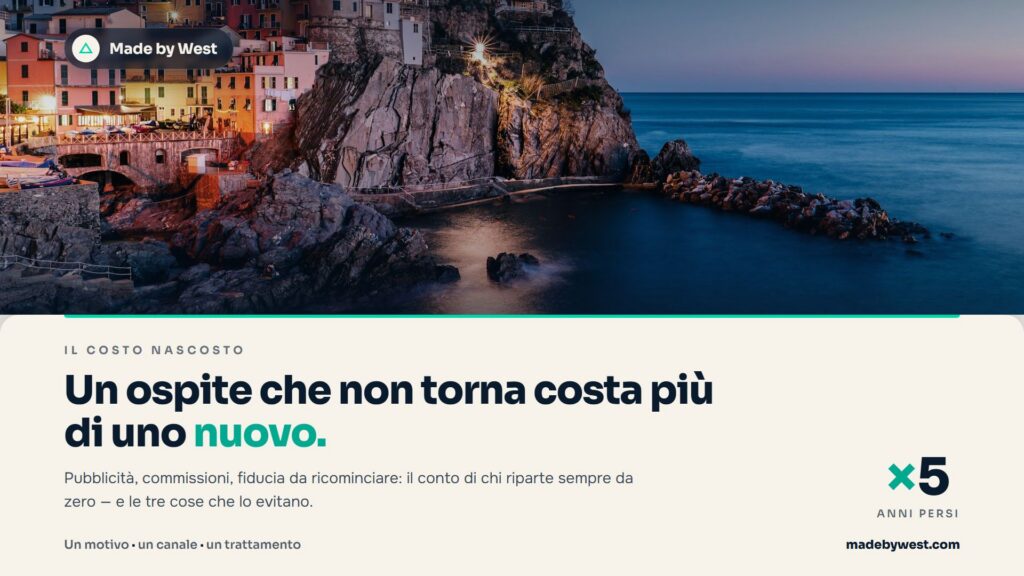
What a guest who doesn’t return really costs you (and how to avoid it)
Talk to Made by West
A new customer costs advertising, time, commissions. A returning customer costs one email. Yet almost every property spends the day looking for strangers and not one minute making the people who already came feel special — the only person on earth who already knows that staying with you is a good idea. Let’s do the math, no fear.
Move 1: calculate the value of who already came
Take the average spend of a stay: room, dinner, extras. Multiply it by the times a happy customer could come back over five years. Now look at what you spent this year on advertising to find one new person, starting from zero trust. The number that comes out is the reason the «already came» guest is the most undervalued person of your season.
Move 2: find out why they leave (it’s almost never the price)
When a guest doesn’t return, the most common reason isn’t cost: it’s the absence of a reason to. Nobody asked them, no ritual is waiting for them, no news from the property ever reached them. The three things that bring people back are simple:
- A reason: the new season, the new dish, the festival, the anniversary of their stay
- A channel: the email that arrives at the right moment, the message that doesn’t end up in spam
- A treatment: «your room», not «a double room»
Move 3: the return is prepared on departure day
The guest walking out the door is warm, knows you, and just paid you. It’s the perfect moment for the «see you next year»: a concrete benefit for booking the return before leaving, a goodbye that becomes an appointment. Those who do it fill weeks in advance; those who don’t, start every season from zero.
The questions we always get
Where do I start, my database is tiny? Better: a hundred real customers are worth more than ten thousand followers. Start with them, one handwritten email.
And what about the OTAs, don’t they own the customers? The guest who spends one night with you is yours if you give them a reason to stay so: the welcome, the direct channel, the memory. It’s work — but it’s the only kind that compounds.
In short
Filling rooms with strangers is the most expensive job in the world. Filling them with people who have already been your guests is the most undervalued: it takes a reason, a channel, a treatment. Let’s start there, if you like.