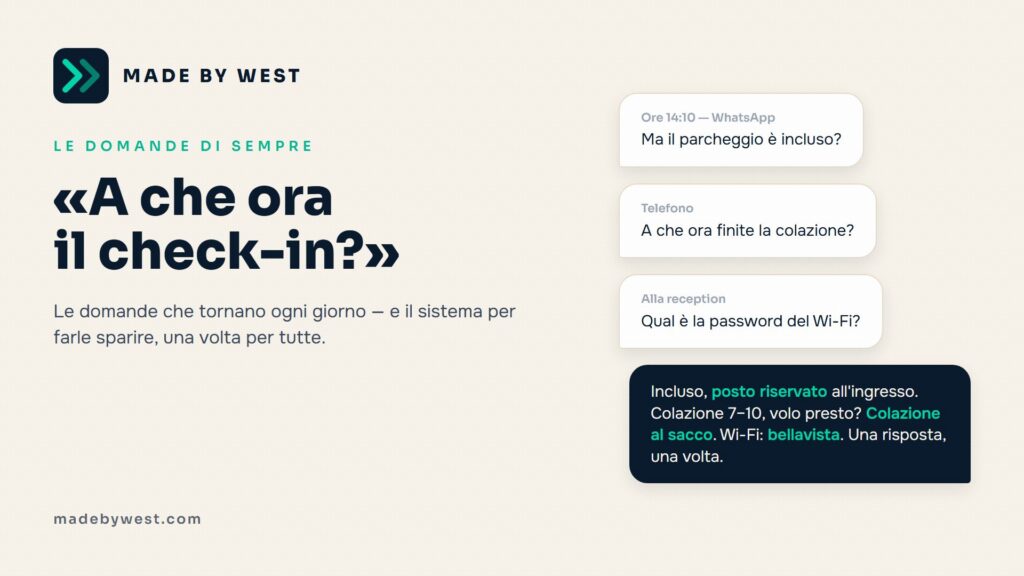
What time is check-in? The questions that come back every day (and how to make them disappear)
Talk to Made by West
It’s 2:10 pm. At the desk, a guest is asking for the Wi-Fi password. The phone is ringing: someone wants to know when breakfast ends. On WhatsApp, the message that arrives every single day lands again: “is parking included?”. These are yesterday’s questions. And tomorrow’s.
It’s not the guests’ fault: the answers only exist in your head, or in a drawer, or in the regret of whoever answered badly because they were tired. Repeated questions are not a people problem — they’re a system problem. And systems are built once.
1. The log move: write the questions down for one week
Take a notepad and put it at the desk (or a note on the phone of whoever’s on shift). Every question from a guest, one line. Nothing scientific: count the tallies. At the end of the week, look at what repeats. You’ll discover that five or six questions cover most of the time you lose every day answering the same things. Those, and only those, are your work.
2. Write the answers once, and write them well
A well-written answer has three qualities:
- It’s short: one sentence that answers, one useful detail.
- It’s written by a person: the tone of someone welcoming, not of a contract. “Parking is included” is fine. “Parking is included — in the evening we keep a spot for you by the gate” is better.
- It ends with the useful thing after the answer: the time, the way, the tip that prevents the next question.
3. Put them where the guest looks before asking
The perfect answer is the one the guest finds alone, before writing to you. The touchpoints that matter:
- The pre-arrival email (a few days before: check-in, breakfast, parking, Wi-Fi — in five lines).
- The website (a real FAQ page, written from your log, not the usual four generic lines).
- WhatsApp (an automatic welcome message with the three essential answers).
- The room (a QR leading to the same page: the first thing the guest looks for is on the nightstand).
4. A frequent question is also a sale
Every answer can end with the right extra, without sounding like selling. “Breakfast is 7 to 10. If you have an early flight, at 6:30 we’ll prepare a breakfast bag for you”: the question becomes a service. This is the step almost nobody takes — and the one that truly changes the front desk’s day.
5. Measure the time it gives you back
After a month, count the log again. The questions that disappeared are time returned to the person in front of you: real hospitality, tips, the sales no FAQ will ever make for you.
The 10 questions that always come back
- What time is check-in? And check-out?
- What’s the Wi-Fi password?
- Is parking included? Where do I park?
- Breakfast: times, what’s included, can it be early?
- Is there a hairdryer? And air conditioning?
- Can we check out a little later?
- How do we get downtown / to the beach?
- A restaurant you’d recommend?
- Can you call us a taxi / is there a shuttle?
- Can we leave our bags after check-out?
Mini FAQ
Won’t making questions disappear make hospitality cold? The opposite: it frees time for real hospitality. Information is a machine; the welcome is a person.
How many FAQs should I write? The ones in your log, no more. Ten perfect answers beat fifty pages nobody reads.
Do they work on WhatsApp too? Yes: the same answers, ready in a phone note, pasted in a second. Consistent even when whoever answers changes.
In short
- Repeated questions are a system problem, not a guest problem.
- One week of logging tells you exactly what to fix.
- Short, human answers, with the extra detail.
- Published where the guest looks first: email, website, WhatsApp, room.
- Every answer can carry a service or an extra.
If you want to build the FAQ system for your property — log, texts and touchpoints — let’s talk.