Hotel website copy: how to write texts that get bookings
Get your website copy reviewed
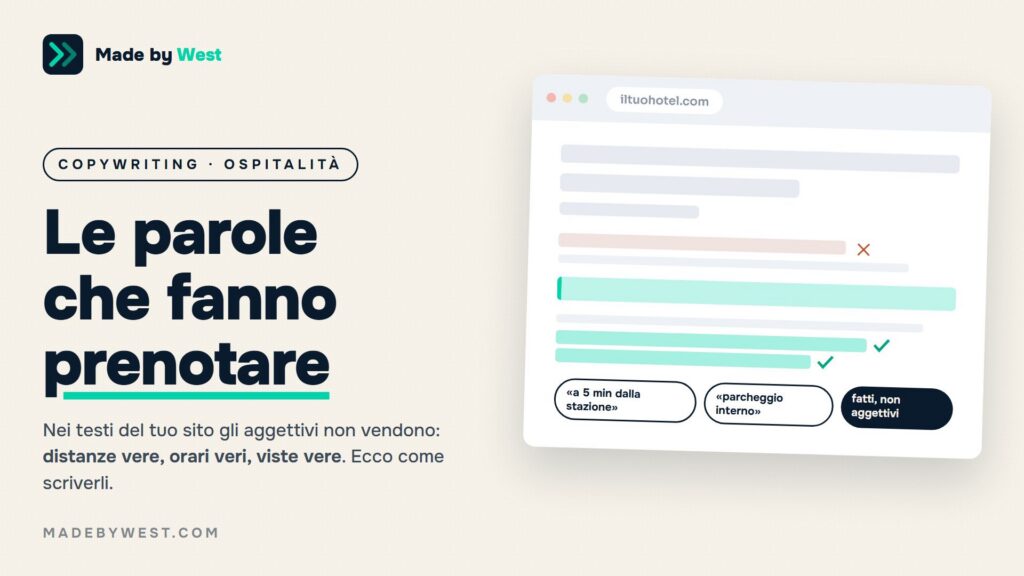
The texts on a hotel website convert when they answer the guest’s questions, not when they describe the property: instead of «a charming property surrounded by greenery», «a 5-minute walk from the station, on-site parking included, breakfast served until 10:30 am». Adjectives don’t book — facts do. The rule is simple: every sentence must say something the guest can verify, compare or picture from the room.
Why adjectives don’t sell
Because they are interchangeable: any competitor can claim to be «charming», «elegant» or «guest-focused». When three properties in the same area describe themselves with the same words, the guest reads them as noise and goes back to the photos and prices. Useful copy is copy only you could write: the view you actually see from the terrace, the name of the jam supplier, the fact that parking is on-site and not “nearby”. The test is easy — take a sentence from your website and ask: «could the hotel across the street write this too?». If yes, cut it.
How to write room descriptions?
The room description is the page that closes the booking, and it’s almost always the laziest one. The moves:
- start from what the guest does in the room, not from what the room is («you drop your suitcase, open the window and hear the market below» beats «bright double room»);
- give the square meters or at least the comparison («the largest in the property»), as long as it’s true;
- name what the guest fears: noise, courtyard view, ground floor — and answer in advance («inner-facing: quiet»);
- list the amenities that actually matter (wi-fi, a/c, minibar, the socket by the bed) more than brochure details;
- one concrete sentence about the bathroom.
What should the hotel homepage say?
The guest lands on the website with three questions: where exactly am I, how much does it cost, why you instead of the other one. The homepage must answer in order: one positioning sentence with the place inside («In the heart of Ortigia, two steps from the market»), true photos, the price or at least a way to check it immediately, and the three things that make you different — written as facts, not slogans. Below that, reviews with replies, because they prove someone reads them. And the booking or contact button must be visible without scrolling.
Frequently asked questions about website copy
Long or short texts? Dense texts: long enough to answer the questions, short enough not to bury the facts. If a page adds no information, cut it without mercy.
Should I write “we” or “you”? You. The guest is the protagonist, the property is the context: «your breakfast», «your parking spot».
Who should write them? Whoever knows the true details and can keep the pen short: it’s often a matter of method more than copywriting. An outside eye helps see the adjectives you can no longer see.
In brief
Hotel website copy works when it replaces adjectives with facts: real distances, real times, real views, and the guest’s fears answered in advance. Room descriptions written by someone who has slept there, a homepage that answers where-how much-why. It’s the cheapest thing to improve and the one that works on every future booking.